Something many may not know about Virginia Woolf is that she had a fondness for clothing. During the 1920s, fashion was changing for women, prioritizing comfort with looser cuts, dropped waistlines, raised hemlines, and more affordable materials such as jersey were becoming more widely used. Virginia Woolf embraced this increase in selection for women. She even considered “frock consciousness” to be one of the many states of consciousness we all have: “My present reflection is that people have any number of states of consciousness: & I should like to investigate the party consciousness, the frock consciousness.” She further explained this state of consciousness in Orlando when she wrote concerning clothing: “They change our view of the world and the world’s view of us.” So “frock consciousness” was the “impact that clothes have on both our inner and outer states of being.”
“I must remember to write about my clothes next time I have an impulse to write. My love of clothes interests me profoundly.”
Virginia Woolf, diary entry
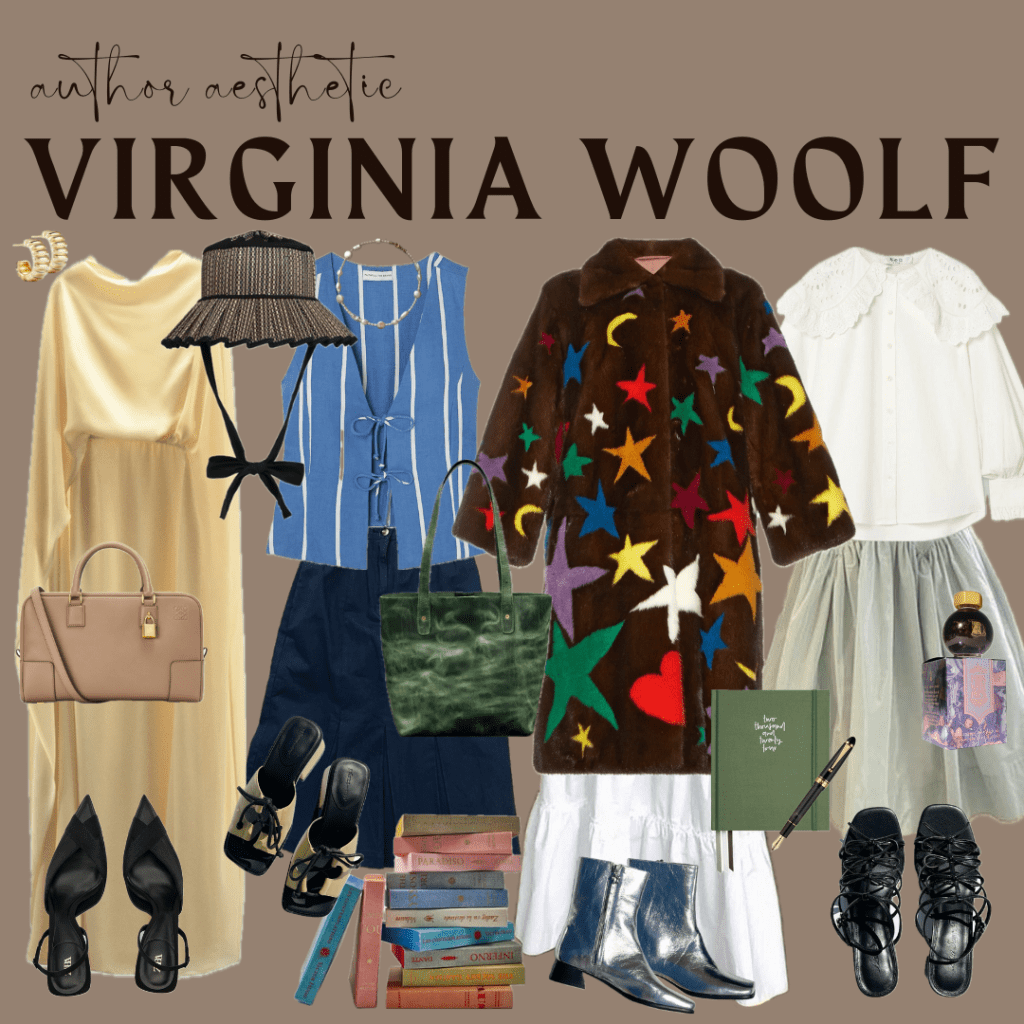
WARDROBE:
For Woolf, the choice of clothing was a form of self-expression. With the increase in outfit possibilities for women in the 1920s and 30s, the option to choose different styles of clothing put more emphasis on self-representation. As much as Woolf loved clothing, she disliked buying clothes, or shopping. Regarding buying suspenders she said: “It is partly, I think, that in order to buy suspenders you must visit the most private room in the heart of a shop; you must stand in your own chamise… I am very shy under the eyes of my own sex when in chamise.” As a result, Woolf mostly kept her clothing minimal and classic but still loved adding statement pieces such as bold collars and florals and her well-known fur coat. She took note of other’s clothing as well and the effect they had on a room, for instance. And while she was drawn to bold pieces and enjoyed wearing them, she was very affected by what others thought about her clothing. For instance, she loved wide-brimmed hats but others thought they were extravagant.
Writing Style & Tools:
Woolf is best known for her stream-of-consciousness style in her novels, which mostly consisted of characters’ inner thoughts and everyday activities and conversations. She used interior monologue to distinguish between the exterior versus the interior — reflective of how she saw clothing and how it represented both the exterior and the interior.
Woolf kept a strict schedule when she wasn’t struggling with mental health issues. After breakfast and her morning bath, from 9:30 a.m. to 12 p.m., she wrote fiction and reviews. She left revision for before or after lunch. Her afternoons were for taking walks. After tea, she would write in her diary or write letters. And her evenings were reserved for reading or seeing friends. She tracked her writing progress and set timetables for her projects. She considered journaling to be a form of practicing her writing, which makes sense since journaling is often stream-of-consciousness and was also her style for writing fiction. But despite Woolf’s strict regime, she was an untidy writer; her desk was often unkempt. But she kept her writing tools minimal. She often wrote on a large board made of plywood with an inkstand glued to it. She used a large quarto notebook of plain paper that was bound up for her and that she covered herself using brightly colored paper. She also enjoyed using different colored inks such as purple, green, and blue but particularly liked purple inks for letter-writing, diary entries, manuscript drafts, and page proofs.
Today, Woolf would appreciate the range of ink colors and how far fountain pens have come. She would particularly like the simplicity of Galen Leather’s The Note Board which holds an A5 notebook and has a slot for a fountain pen (use this link for a discount on Galen Leather products). As a writer with a strict routine and projects to progress, she would prefer a planner/diary that allowed her the flexibility to customize every day. This Emma Kate Co. diary would suit her best.
HOBBIES:
There isn’t much about Woolf’s hobbies other than writing. But from what I could gather, she enjoyed walking, reading, traveling, watching concerts, and bookbinding. She would be impressed with the ease of transportation today. In order to accommodate her frequent travels, she would prefer a Kindle for reading. She would also appreciate the art of the Slow Design Canvas journals that are handmade in Italy. She would have a “Bookstagram” where she shares her favorite books and writes reviews along with a blog sharing her travels and inner thoughts with her readers.
If you’re interested in reading more about Virginia Woolf, I recently wrote an essay “On Being Alone” on my fiction and essays substack featuring Virginia Woolf’s views on creativity and being alone.
xx
Disclaimer: “Author Aesthetic” is a series I created for fun and to entertain my imagination. While the facts about the authors are true, my assumptions of what they would be like today are fictional and my own opinion.
 bonitappétit