Sylvia Plath was an American poet and author known for The Colossus and Other Poems, Ariel, and The Bell Jar. She was also known for popularizing the genre of confessional poetry. Plath published her first poem at age 8 and her only novel, The Bell Jar, at age 30 reshaping 20th-century literature. Her use of personal experiences and exploration of mental illness, femininity, and identity has moved generations of writers to use the power of their experiences and psychological struggles to contribute to their art.
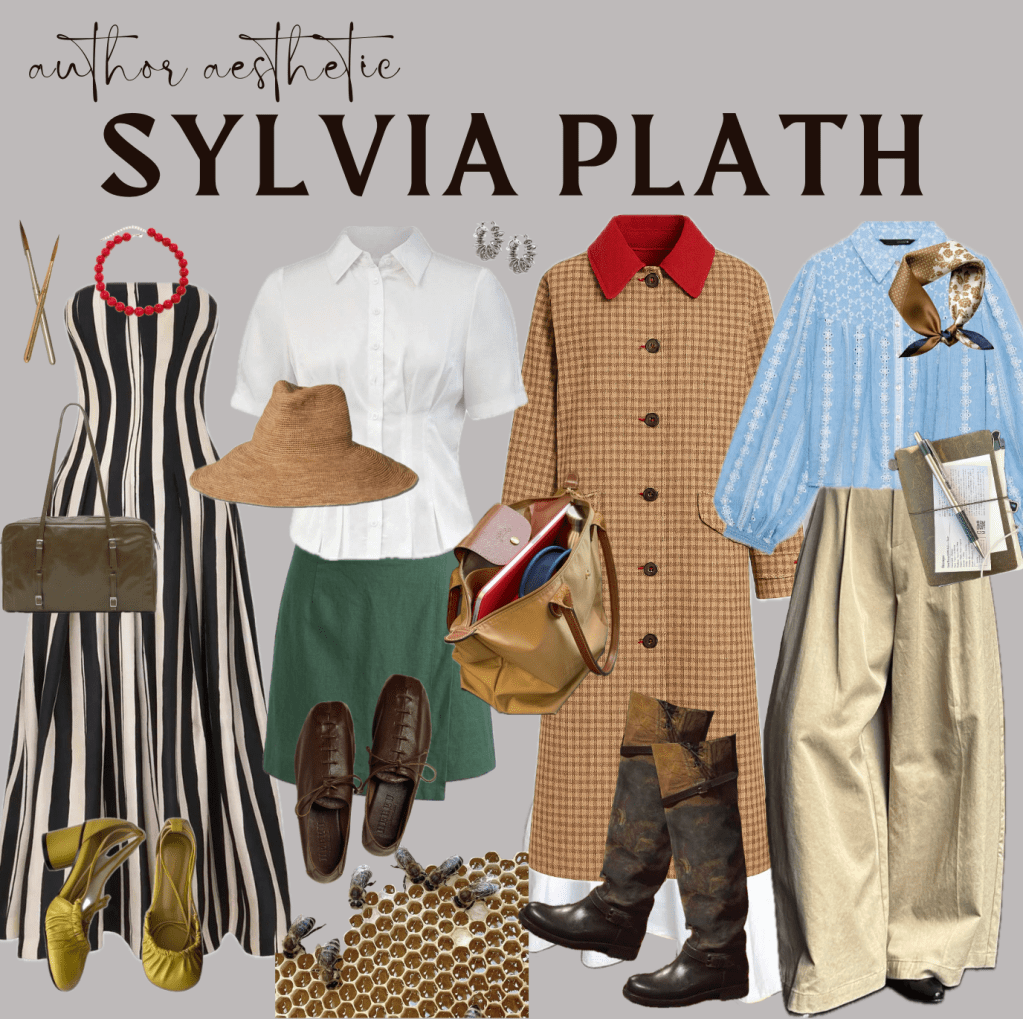
WARDROBE:
Sylvia Plath used fashion as a form of “armor and self-expression.” Her style ranged from 1950s preppy (plaid skirts and headbands) to a sleek, tailored, and confident modern look. She was most known for wearing red lipstick, tailored black clothing, and for coordinating the colors of her accessories. She would also tweak her style according to what her lifestyle was at the moment. For example, during her New York internship, her style was more sophisticated and tailored.
Plath understood the power of dress and how clothing can shape the self. She noted in her journals that she worked better in certain colors or textures that didn’t “war” against her body or thought. Her clothing now serves as a form of her creative expression becoming displays in literary exhibitions.
“Why can’t I try on different lives, like dresses, to see which fits best and is more becoming?”
— Sylvia Plath, The Unabridged Journals of Sylvia Plath
Today, Sylvia Plath would have adopted the sleek look while still adding elements that would bring out her personality. Think: Damson Madder, Paloma Wool, and Ralph Lauren. She would dress in a way that would support her hobbies and would choose colors that reflect her love of nature.
WRITING STYLE:
Although more well-known for her novel, The Bell Jar, Plath had a passion for poetry. She featured an element of nature in almost every poem — water, trees, bees, changing seasons, etc. She particularly had an infatuation with the stars. The words she chose for her poems reflected her intellect and education, expressing the depths of her depression and her battle between will and responsibility. She often drafted her poems on paper and would edit them multiple times before being satisfied with the end result.
“And by the way, everything in life is writable about if you have the outgoing guts to do it, and the imagination to improvise. The worst enemy to creativity is self-doubt.”
— Sylvia Plath, The Unabridged Journals of Sylvia Plath
As far as her materials and writing process, Plath was meticulous with her typewriter, enjoyed using fountain pens in her letter-writing, and used various types of paper, even repurposing hotel stationery. Her writing process involved studying her own journals and notes. She used her experiences as raw materials for future compositions and viewed her journals as a creative laboratory and data bank, often capturing moments as they happened, to ensure that she had the “exact emotional temperature” or “visual texture” that was needed for her art. She was never rigid with her note-keeping; she viewed her journals as a rehearsal space and wrote notes in multiple notebooks as needed.
Authors who influenced Plath’s poetry:
- William Butler Yates
- W.H. Auden
- William Shakespeare
Artists she would enjoy today:
- Lana Del Rey (imagery)
- Taylor Swift (confessional style)
- Ottessa Moshfegh (addressing mental health)
HOBBIES:
Plath had multiple hobbies: beekeeping, which she took up with her husband; sketching, often including drawings in her letters and diaries; cooking/baking, she documented her meals; music/literature, piano helped her break through creative blocks and she was an avid reader; fashion, she had a keen interest in clothing and styles. Her hobbies acted as a source of inspiration and as a means of grounding herself.
If Plath were alive today, she would have enjoyed Louise Carmen and Paper Republic journals to help her keep her hobbies all in one place. She could document her meals/recipes, jot down inspiration for her poetry, keep a beekeeping log, and have a sketchbook all in one journal. She would have also enjoyed the thrill of thrifting and finding inspiration in experimenting with different styles.
“I can never read all the books I want; I can never be all the people I want and live all the lives I want. I can never train myself in all the skills I want. And why do I want? I want to live and feel all the shades, tones and variations of mental and physical experience possible in my life.”
— Sylvia Plath, The Unabridged Journals of Sylvia Plath
Disclaimer: “Author Aesthetic” is a series I created for fun and to entertain my imagination. While the facts about the authors are true, my assumptions of what they would be like today are fictional and my own opinion.

